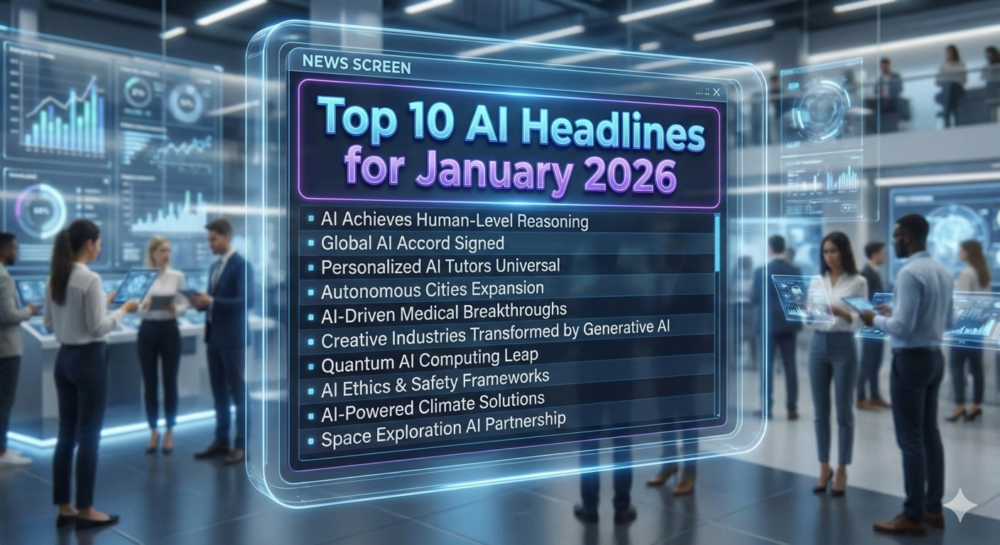
January 2026, was a pivotal moment in the "AI Super-Cycle," characterized by a shift from software experiments to imperial-scale infrastructure and agentic systems
Here Are the Top 10 AI Headlines for January 2026, Along with Their Verified Sources
White House Releases "The Great Divergence" AI Report
This White House report, "Artificial Intelligence and the Great Divergence," frames AI as a transformative force comparable to the 19th-century Industrial Revolution. It warns of a "second Great Divergence," where nation's leading in AI investment and adoption—specifically the United States—achieve exponential economic growth relative to global laggards.
Under the Trump administration’s roadmap, the U.S. aims for total AI dominance through aggressive deregulation, infrastructure expansion, and technology exports. By treating AI as critical national infrastructure, the administration seeks to outpace competitors in a race where performance metrics double every few months, ensuring America remains the definitive global leader. Read More!
Source: White House Research / MLQ.ai
OpenAI & Jony Ive Confirm 2026 Hardware Timeline
OpenAI is officially on track to unveil its mystery AI wearable in 2026, a timeline confirmed by executive Chris Lehane at Davos. Developed alongside design icon Jony Ive, the project remains secretive, though rumors point to AI-powered earbuds codenamed “Sweet Pea.” Aiming to disrupt the AirPods market, this screen-free companion seeks to succeed where earlier hardware like the Humane Pin failed. By combining Ive’s aesthetic mastery with ChatGPT’s intelligence, OpenAI is positioning itself to lead the post-smartphone era. This strategic pivot marks a critical evolution from software giant to a holistic, high-authority hardware-software ecosystem. Read More!
Source: Mashable / Axios House Davos
The "Pax Silica" Whiplash: H200 Exports Approved, Then Tariffed
The Trump administration has introduced a landmark "Pax Silica" policy, approving the export of Nvidia’s powerful H200 AI chips to China—but with a significant 25% tariff. This strategic move marks a shift from total trade restrictions to a "pay-to-play" model designed to generate federal revenue while maintaining a competitive edge. By taxing advanced compute exports, the administration aims to fund domestic R&D and incentivize U.S.-based manufacturing. Industry analysts view this as a high-stakes gamble to monetize American technological dominance without fully decoupling, though it faces criticism for potentially accelerating China’s pursuit of sovereign chip production. Read More!
Source: Tech Wire Asia / The Guardian
ServiceNow & OpenAI Partner for "Agentic Enterprise" with GPT-5.2
ServiceNow and OpenAI have announced a three-year partnership to natively integrate OpenAI’s GPT-5.2 and frontier models into the ServiceNow AI platform. This January 2026 agreement focuses on "agentic AI," introducing multimodal features like real-time speech-to-speech agents and "computer-use" models designed to automate legacy IT systems. Managed via ServiceNow’s AI Control Tower, the deal provides enterprises with scalable, out-of-the-box AI capabilities without bespoke development. Following $11 billion in 2025 acquisitions, ServiceNow is positioning itself as the premier hub for enterprise AI operations, making OpenAI its exclusive natively embedded model to drive efficiency. Read More!
Source: Reworked / Simply Wall St
Daily Workplace AI Usage Climbs to 12% in Q4 Report
Gallup’s Q4 2025 report reveals that while overall U.S. workplace AI adoption stabilized at 46%, the frequency of usage is deepening. Daily users reached 12% and frequent users rose to 26%, driven largely by knowledge-based industries like technology and finance. Adoption is highest in remote-capable roles (66%) compared to non-remote roles (32%). A significant "usage gap" persists between hierarchical levels; 44% of leaders use AI frequently, compared to just 23% of individual contributors. This disparity suggests that leaders perceive greater utility in AI, highlighting the need for organizations to identify clear, role-specific use cases to broaden effective integration. Read More!
Source: Gallup Workplace
IBM & e& Unveil Agentic AI for Governance at Davos
At Davos 2026, e& and IBM announced a groundbreaking partnership to deploy enterprise-grade Agentic AI focused on governance and compliance. Leveraging IBM’s watsonx Orchestrate, the collaboration introduces autonomous agents designed to navigate complex regulatory landscapes, monitor risk, and execute high-stakes workflows without manual intervention. This shift marks the evolution of AI from passive assistants to proactive "digital employees." By merging deep systems expertise with sovereign data privacy, the initiative provides a blueprint for Strategic Intelligence (SI), allowing global enterprises to automate trust and scale operational efficiency in an increasingly regulated digital economy. Read More!
Source: IBM Newsroom
From Utility to Companionship: CES 2026 Trend Recap
CES 2026 signals a definitive pivot: AI has moved from a utility tool to a primary solution for the "loneliness epidemic." As reported by the Indiana Daily Student, this year’s electronics landscape is dominated by "emotional presence" tech designed to simulate human connection. Startups are unveiling advanced AI companions and conversational robots aimed at isolated seniors and Gen Z. While these devices offer a "silicon bridge," they ignite fierce debate over the ethics of replacing human intimacy with algorithms. Ultimately, 2026 marks the year we began asking if technology can truly cure the heart or merely masks our isolation. Read More!
Source: Source: Indiana Daily Student (CES Analysis)
Europe Mandates "AI Gigafactories" for Sovereign Compute
At Davos, IBM champions the transition from generative AI experiments to Agentic AI ecosystems that redefine enterprise productivity. Centered on "Strategic Intelligence," IBM’s roadmap focuses on operationalizing autonomous agents within hybrid cloud environments. Key sessions emphasize governance, digital trust, and quantum-safe security as foundational to the new economy.
Beyond efficiency, IBM advocates for "Sovereign AI" and sustainable technology to bridge the global digital divide. By embedding intelligence into core business logic, IBM aims to transform global organizations into resilient, AI-first entities where technology acts as a trusted collaborator, balancing rapid innovation with ethical responsibility and long-term value. Read More!
Source: EuroHPC / IBM Davos Briefing
DeepSeek-V4 Achieves Open-Source Parity with Closed Models
As of January 25, 2026, MarketBeat identifies a strategic rotation into AI pure plays, highlighting three high-volume stocks: BigBear.ai (BBAI), Hut 8 (HUT), and SoundHound AI (SOUN).
BigBear.ai leads in decision intelligence for national security, while Hut 8 capitalizes on the infrastructure surge through AI colocation and data centers. SoundHound AI remains a dominant force in conversational voice interfaces for automotive and IoT sectors. While these companies offer direct exposure to the 2026 AI super-cycle, investors are cautioned regarding high valuation scrutiny and volatility compared to broader markets. The focus has officially shifted from chip production to application-layer execution. Read More!
Source: MarketBeat AI Watch
JPMorgan Reclassifies AI Spend as "National Infrastructure"
JPMorgan maintains a technology budget of roughly $17 billion annually by reclassifying AI as "core infrastructure," they are placing it in the same "non-negotiable" category as data centers, electricity, and cybersecurity. In 2024–2025, AI was often treated as a "discretionary" expense—something that could be cut if the market turned. In the 2026 fiscal landscape, JPMorgan views AI as the "plumbing" of the bank. You don't cut the plumbing to save money; if the plumbing fails, the house doesn't function. Read More!
Source: Banking Exchange
Check out our: Top 5 AI Videos on YouTube January 2026
A Short Domain Name Like 2si.com is Perfect for AI
AI thrives on productivity, performance, and reliability and so should your brand. That’s why 2si.com is a perfect fit for innovators in the artificial intelligence, AI technology space.
It’s:
- Short: Just three characters—2si.com is easy to recall, type, and share.
- Versatile: Works for AI, robotics, smart tech, and industrial automation and so much more.
- Brandable: Looks sharp on screens, business cards, and investor decks, billboards, advertisements, etc.
While most premium domains are already taken or priced out of reach, 2si.com is a rare opportunity—perfect for a company that’s thinking ahead, way ahead.
Instant purchase option on a globally trusted registrar.
Secure transaction via Sedo’s domain marketplace.
Looking for a Different Domain?
If 2si.com isn't the perfect fit for your brand, you can explore thousands of other premium domains through our trusted partner, Sedo. You can use the search tool below to find available premium domain names that match your business, product, or idea, and then take the first step toward owning a powerful digital identity.